
Research that earns a seat in the roadmap
The research that changes product direction is not louder. It is clearer about what is known, what is still fragile, and what decision the team can make now.

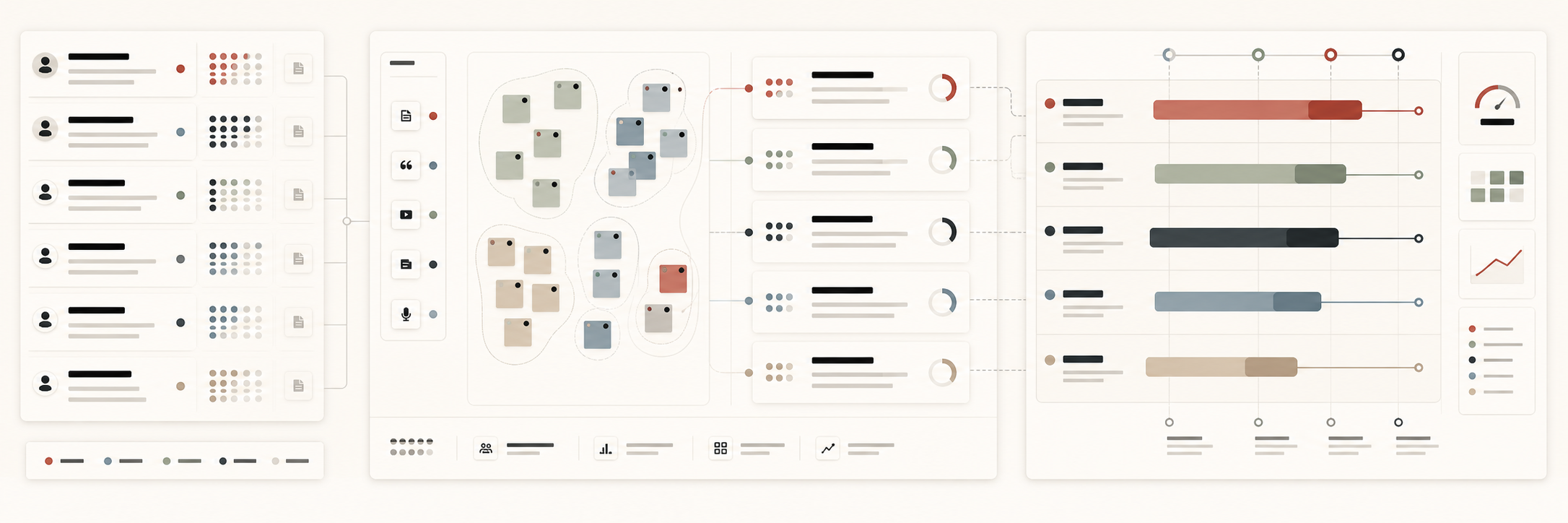
Research earns roadmap influence when it stops being a report and becomes a decision system.
I have seen strong research get ignored because it arrived as a beautiful deck after the roadmap had already hardened. I have also seen scrappy research change executive direction because it named the right risk at the right moment, with just enough evidence for the team to act responsibly.
The difference is not polish. The difference is decision relevance. Product teams do not need more research artifacts. They need a reliable way to understand what is true enough to shape the next move.
Start by naming the decision
Before I ask a team to run interviews, I want to know which decision the research is supposed to inform. Are we choosing a segment? Prioritizing a workflow? Testing whether a concept reduces burden? Finding the minimum review state a clinician will trust? Deciding whether a signal is strong enough to shape sprint scope?
Without that frame, research becomes a collection of interesting observations. Interesting is not enough. A roadmap needs tradeoffs.
In AI-native healthcare work, this matters even more because there are so many seductive questions. What can the model do? Could the interface generate something useful? What would providers accept? What would reduce documentation burden? Each question may be valid, but they do not all belong in the same study.
Separate stated needs from latent needs
People often tell you what they want in the language of the tools they already know. Providers may ask for a faster note, a better summary, or fewer clicks. Those statements matter, but they are rarely the full insight.
The useful pattern often sits underneath: they want to regain confidence before the next patient walks in. They want to avoid missing something clinically relevant. They want the system to reduce administrative drag without making them feel like they have lost authorship of the record.
Good synthesis keeps both layers visible. Stated needs help you improve the current workflow. Latent needs help you design the next one.
The gap between what people ask for and what their behavior reveals is where the roadmap gets interesting.
Label signal strength honestly
One of the simplest ways to make research more useful is to stop presenting every insight with the same confidence. I use a plain signal-strength model:
- Weak signal: one credible source or one observed behavior. Useful for exploration, not commitment.
- Moderate signal: two independent sources pointing in the same direction. Useful for prototype direction and risk framing.
- Strong signal: three or more credible sources, or a pattern reinforced by behavior and data, with domain expertise. Useful for product decisions.
This is not academic theater. It changes the conversation. A weak signal can still be important, but it should not be sold as fact. A strong signal should not be buried in a theme bucket next to something one person mentioned once.
Signal strength lets PMs, designers, engineers, and leaders understand how much weight a finding should carry.
Keep traceability alive
Synthesis is dangerous when it becomes too smooth. A clean theme can make thin evidence look solid. Memorable quotes can make an edge case look universal. A polished insight can detach from the interview moment that gave it meaning.
That is why I care about traceability. Every important claim should be traceable back to the source: the participant, the note, the behavior, the transcript, the customer context, the metric, or the domain constraint. The goal is not to make everyone reread everything. The goal is to make the claim inspectable.
In practical terms, that means research repositories, signal registries, decision records, and synthesis notes should connect. If a design decision cites a signal, I want to know where the signal came from and how strong it is.
Translate findings into requirement families
Research rarely maps cleanly to one feature. It usually points to a family of requirements: visibility, control, recovery, confidence, accountability, continuity, or speed. Naming that family helps a team avoid overfitting to the first solution idea.
For example, if providers do not trust an AI-generated clinical summary, the requirement is not simply "add citations." The real requirement family may include provenance, draft state, correction paths, source inspection, review burden, and clear authorship. Those requirements can shape multiple surfaces across the product.
This is where research becomes roadmap material. It moves from "users said X" to "the product needs to support Y because the evidence shows Z."
What leaders need from research
- The decision the research informs.
- Strongest signals and their source strength.
- Product risk if the team ignores the evidence.
- User behavior behind the stated request.
- The requirement family, not just the feature idea.
- The next test that would strengthen or invalidate the direction.
That structure gives research a seat in the roadmap because it respects the work the roadmap has to do. Roadmaps are not a list of user quotes. They are bets under constraint. Research earns influence when it improves the quality of those bets.
Research and AI-native product development
AI makes this discipline more important, not less. A model can synthesize transcripts, cluster themes, and draft findings quickly. That is useful. It can also make uncertain evidence sound more certain than it is. That is dangerous.
My view is the same here as it is elsewhere: AI can help prepare the work, but humans need to own the judgment. Researchers and designers still have to decide whether a theme is real, whether the evidence is strong enough, whether a behavior matters, and whether the recommendation respects the user's actual workflow.
Research earns the roadmap when it protects the team from building on vibes, including AI-generated vibes that happen to be well-written.
FAQ
How does UX research earn influence on the roadmap?
It earns influence by connecting evidence to product decisions, risks, requirement families, and next actions. The goal is not just insight. The goal is better product judgment.
What is signal strength in UX research?
Signal strength is a practical confidence label. Weak signals are exploratory, moderate signals can guide prototypes, and strong signals can support product decisions.
Why is traceability important?
Traceability lets a team inspect where a claim came from and how much weight it should carry. It prevents polished synthesis from overstating the evidence.
How should product teams use AI in research synthesis?
Use AI to prepare, cluster, summarize, and compare. Keep interpretation, confidence, ethics, and product recommendations under human review.
What should researchers give executives?
Executives need the decision, the strongest evidence, the risk of ignoring it, and the recommended next move. They do not need every observation at the same level of detail.
Jay Trainer
Design Leader
Design executive focused on AI-native healthcare workflows and UX research, with product design leadership and design systems, plus human-in-the-loop product development.