
Measuring design success
Design success is not only whether the interface looks better. It is whether the experience helps users and the business make measurable progress.
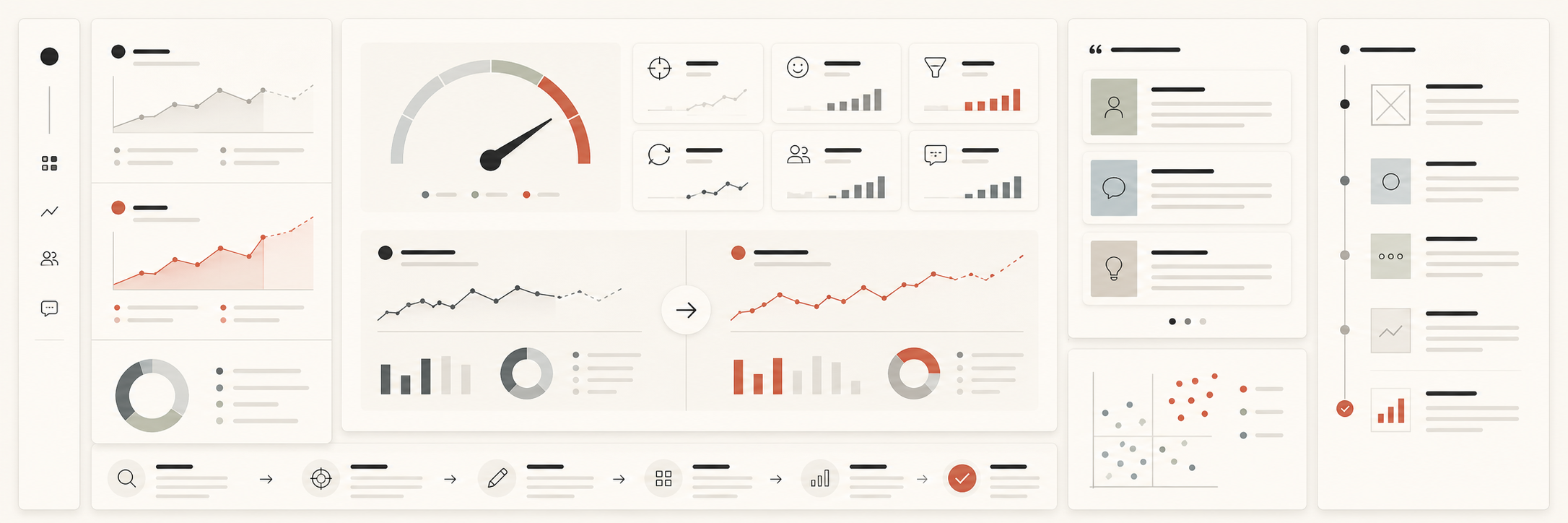
A practical way to connect design work to task success, satisfaction, conversion, retention, support volume, and business outcomes.
Start with the user outcome
The first question is what user behavior should improve. Task completion, time on task, error rate, comprehension, satisfaction, and confidence often reveal whether the design is working.
Connect to business results
Design work should also connect to product outcomes such as activation, retention, conversion, expansion, reduced support volume, or fewer operational errors. The metric depends on the product strategy.
Use qualitative and quantitative evidence
Analytics show what happened. Research explains why. A healthy measurement model combines both, especially when decisions affect complex workflows.
Measure before and after
Teams need a baseline. Without a before state, it is hard to know whether a redesign improved anything beyond stakeholder preference.
- Start with evidence before choosing a solution.
- Make the decision model visible to product, design, engineering, and leadership.
- Connect craft to measurable user and business outcomes.
FAQ
How do you measure design success?
Measure design success with user metrics, business outcomes, usability findings, satisfaction signals, and post-launch performance against a baseline.
What are common UX metrics?
Common UX metrics include task success, error rate, time on task, satisfaction, comprehension, adoption, retention, and support volume.
Why combine qualitative and quantitative data?
Quantitative data shows patterns at scale, while qualitative research explains the reasons behind those patterns.

Jay Trainer
Design Leader
Design executive focused on AI-native healthcare workflows, UX research, product design leadership, design systems, and human-in-the-loop product development.