About
I lead design organizations and build AI-native products that earn trust.
I'm Jay Trainer, a Design Executive and Sr. Director, Product Design, AI-Native. I bring 20+ years in product design, 15+ leading design teams and orgs, and I stay hands-on at the edge of AI because the only way to lead design now is by example.
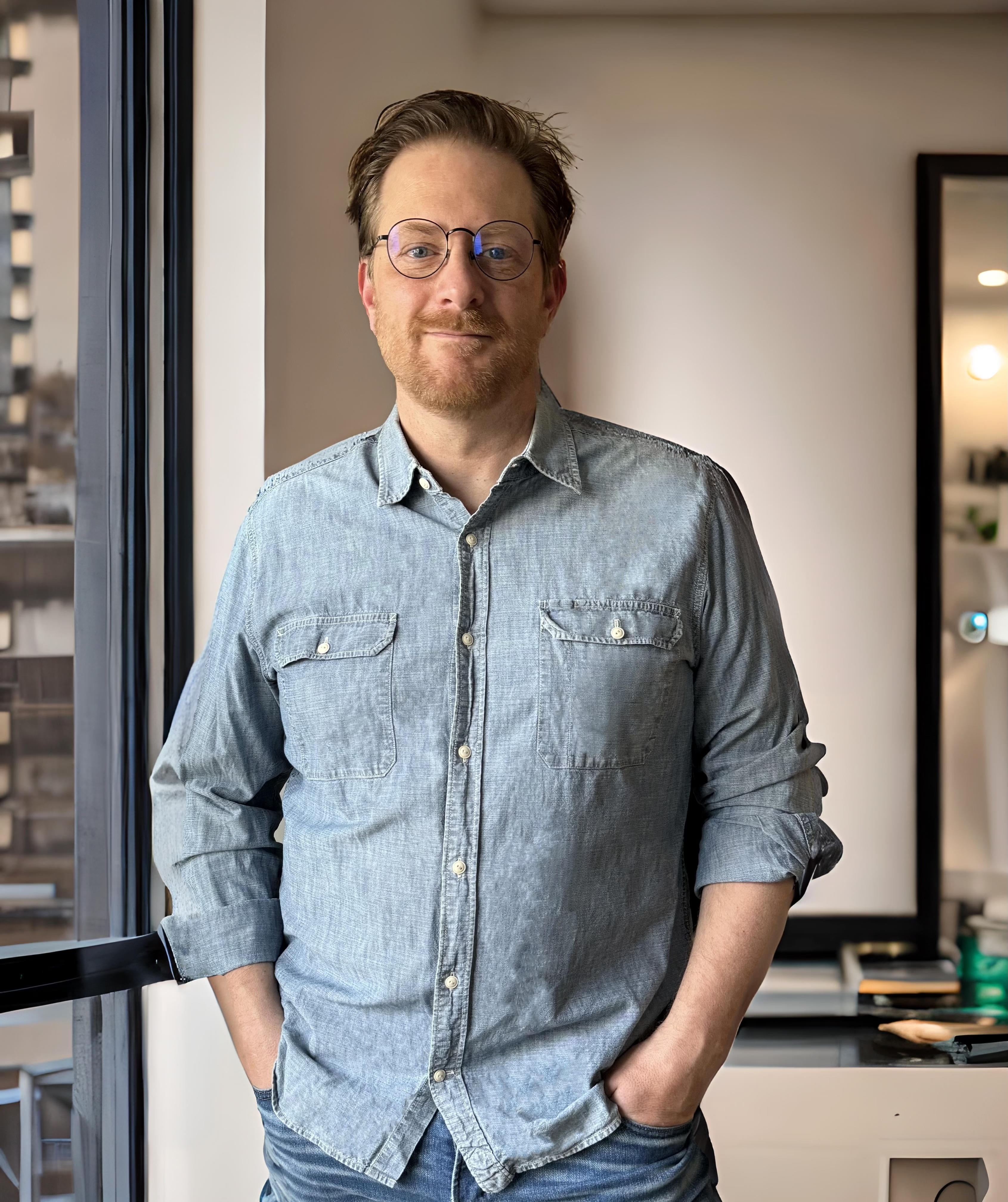
My work sits where complex domains meet the people who use them, and where proven design leadership meets hands-on AI craft.
I bring 20+ years in product design, 15+ leading design teams and orgs for complex digital products at Tebra, Kaiser Permanente, Life360, Glassdoor, plus advisory work for IDEO, AT&T and Sony. I build and develop teams, raise the bar on craft and translate user insight into product strategy and design systems, with measurable business outcomes.
I'm also a prolific, hands-on AI-native builder. I design and run multi-agent orchestration systems, ship production-grade prototypes myself, and spend hours every day at the live edge of AI tooling: building the learning systems, agent harnesses, and operating models that help whole teams use AI with judgment and safety, grounded in craft.
Why I still build
Most senior leaders climb away from the work. For this moment, I've chosen the opposite.
AI has collapsed the distance between intent and a working experience, and that changes what leadership is. A leader who can't build can no longer fully see the work their teams are doing, set a real bar, or honestly mentor people through a transition they haven't made themselves. So I do the work, in the open, on real systems.
Thirty years of craft isn't a reason to step back from this. It's the reason to dig in. Deep craft, systems thinking, and research discipline are exactly what make hands-on AI work good rather than merely fast. I hold myself to that standard on purpose (higher than I'd ask of any team) because it's the only honest way to set the bar, and it's what lets me grow elite teams in a market moving faster than any I've seen.
Where I've led
Sr. Director, Product Design, AI-Native
Lead Tebra's AI-native product design practice: the agent-ready SDLC, with the harness and quality gates behind it, and a 3-5 person design team, partnering with Product and Engineering, plus GTM, among executive partners.
- Defined the AI-native SDLC and agent harness for a Tebra platform migration: typed run contracts, dry runs, stop conditions, autonomy gates, and audit trails.
- Direct the AI-native provider workflow (Otto) through beta, defining how AI earns a clinician's trust: AI drafts and recommends, the clinician reviews and approves, deterministic systems own the record.
- Run the AI-augmented team operating model (a small team working alongside specialized AI agents under human review) and the design-quality gates that keep fast work grounded in evidence.
Director, Product Design, Patient Experience
Owned design for Tebra's all-in-one patient experience platform and its AI-native provider-workflow initiatives.
- Led the design team building an all-in-one patient experience platform: online scheduling and automated reminders, plus digital forms and HIPAA-compliant secure messaging.
- Led the design of the AI-native provider workflow (Otto) from concept toward beta, grounding it in provider research and evidence-traced requirements.
- Architected a strategic 2-year UX roadmap and built a live flow and design-system review environment for cross-functional critique of end-to-end workflows.
Director, Product Design, Care Delivery
Led product design for Tebra's clinical product: redesigning a decade-old EHR around the provider's day and defining reviewable AI documentation.
- Led design for an AI-powered clinical documentation system (AI-generated SOAP notes, patient-history analysis, and provider review), reducing administrative burden while preserving clinical accountability.
- Architected a strategic 2-year roadmap for AI integration, from proof-of-concept to implementation patterns.
- Led user research initiatives that drove notable usability improvements and higher customer satisfaction.
Principal Product Design Lead
ACAA, Receive Care & Navigate to Care. UX design and research leadership across Kaiser Permanente's digital health ecosystem, one of the largest integrated health systems in the U.S.
- Partnered with executive stakeholders on product roadmaps, driving innovation in telemedicine and digital health.
- Architected a design system spanning 100+ digital touchpoints.
- Led design and research across care-access products with a critique-driven, customer-centered practice.
Head of Design
Set UX vision and led design execution for the core family-safety and location-sharing product.
- Spearheaded a core redesign of the family-safety experience, simplifying onboarding, then tightening the core loop.
- Aligned design with strategy, contributing to a 22% increase in premium conversions.
- Advanced a reusable design-system approach so new features shipped with less UI fragmentation.
Senior Director, User Experience, Product Design & User Research
Built the design organization and practices that supported product scale during a high-growth period.
- Built and led a 20+ person UX, product design, and research team.
- Executed a UX strategy that contributed to Glassdoor's growth and eventual $1.2B acquisition.
- Spearheaded Glassdoor's first comprehensive design system.
Independent Consultant: Product Design & UX Strategy
Advised clients including IDEO, AT&T and Sony on product design strategy and UX direction, with stakeholder alignment.
- Developed strategic design plans aligned to client business objectives.
- Established design standards that improved consistency and quality, plus delivery.
What I build to stay sharp
This practice is on the record: Tebra's peer-nominated AI Disruptor IMPACT award for Q2 2026, announced by the company in July 2026.
Learning Atlas
A visual learning system that turns the AI firehose into working knowledge: every saved video becomes a model and a check, plus a small build, not passive inventory. It doubles as how I help designers move from prompt experimentation to repeatable, evidence-backed practice.
A product-development AI team
Five specialized agents (research, strategy, design, PM, and engineering) sharing one inspectable memory. Signal-maturity gates prevent building on vibes, and a disagreement protocol surfaces conflicts for a human call instead of silently averaging them. The agents bring the lenses; I stay accountable for the decisions.
Clarity UX
An AI-native operating system for the messy middle of product development: the decision surface between artifacts. Built on a four-step loop, Pull → Shape → Decide → Build, it keeps requirements, screens, comments, and handoff inspectable so agents can help without anyone losing the thread.
Hours a day at the edge
I track every meaningful model and tool, plus technique, the moment it ships, and pressure-test the claims. The point isn't novelty; it's designing the orchestration model itself rather than just operating someone else's, so my bar and my team's bar stay calibrated to what's actually possible this week.
Principles
Evidence over enthusiasm
Product direction stays grounded in workflow evidence and honest signal strength, not abstract AI hype, including AI-generated vibes that happen to be well-written.
Humans stay accountable
AI proposes and recommends; experts review and approve; deterministic systems own the facts. Human-in-the-loop is a promise that the human's job is genuinely easy to do well.
Craft is trust
AI raises the penalty for weak craft, because more people can now produce interface-shaped things quickly. Quality is whether the product explains itself under pressure.